The Coronavirus pandemic is one that is known and experienced by all: mask wearing, constantly sanitizing your hands, and even sometimes quarantining for weeks on end, are all processes that have been normalized by this global pandemic that has struck our society for two years. However, as strict as the protocols may seem in the U.S, those living in China have experienced a much more severe containment of the virus: Draconian lockdowns. The word Draconian is derived from the ancient Greek politician Draco, who was known for his cruel “Draconian” laws and punishments to the people of Athens: as a result, Draco became synonymous with a law that is harsh and severe.
The Lockdowns that China instituted around their nation defines exactly this: cities with millions of people are quarantined whenever an outbreak of COVID hits the urban centers, and the Chinese people are forced to stay in their homes, and not even allowed to exit their residencies to obtain groceries. This practice was noted to be extreme, yet it saw progress containing the virus, and the country eventually saw their number of covid cases drop down to about a 100 per day: for a country with billions of people, that number relatively equates to zero in compression to its population. However, more recently, the Omicron variant of the Virus has been spreading around many cities in China, forcing them to once again enforce the Draconian lockdowns.
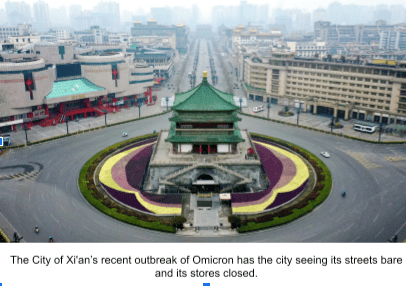
For example, in Xi’an, a chinese city that roughly contains 13 million peoples, a recent outbreak of the Omicron variant has the government enforcing the lockdown, leaving its streets barren and its businesses closed. Residents of the city are not even allowed to exit their residencies for essential errands, such as grocery shopping; as a result, food shortages have occurred as many people in Xi’an cannot buy new food supplies, and many have resorted to bartering within their own apartment complexes. The Chinese government does its best to hand out food parcels to the residents of Xi’an, but has yet to find an effective system that efficiently guarantees that 13 million people will be handed their food. Along with food shortages and businesses being closed, the city of Xi’an has also faced more humanitarian problems in its medical system. In order for citizens to be allowed entry into Xi’an hospitals, they must submit a Covid test that was taken in the last 48 hours of their appointment, and will only be allowed if they submitted this test. Of course, when a medical emergency occurs, there is not enough time to submit a Covid test to reserve an appointment for the hospital. Several Xi’an citizens in dire need of medical assistance had been denied entry into the Xi’an hospitals for not submitting a Covid test. This included a man who was suffering from a heart attack, who sadly passed away outside the hospital doors due to a lack of medical assistance. Such strict conditions for entry to a hospital for those in a medical entry could be argued to breach the basic codes of human rights, yet is one of the many problems that come with Xi’an’s Draconian lockdown.

In addition to China’s domestic problems due to their Draconian approach to Covid, the lockdowns that have occurred in China impact the international economy; China, economically, is known for its cheap labor and numerous trading ports along its coasts, and with the integration of its draconian lockdowns, these ports and factories that manufacture $2.49 trillion worth of the world’s goods are suddenly shut down. This is extremely bad news, especially for mega corporations (such as Samsung), who have numerous factories set up in cities like Xi’an, and have been hit by millions of dollars by the closing of these factories. Other companies, such as Foxconn, which assembles the iPhone on behalf of Apple, have started to shift their factories from China to other countries like India and Malaysia; however, this decision also causes the company millions of dollars, and is an overall lose-lose situation for the many international companies who rely on China to produce their products.
All in all, China’s “Draconian” approach to dealing with the Covid-19 outbreaks have seen little success, and have contributed to the formation of more problems than solutions. The Draconian lockdowns are both negatively affecting the lives and economies in domestic China and those who live in first world countries whose companies rely heavily on China to manufacture their goods. From food shortages to extended periods of economic downturn, China’s Draconian lockdowns can only be characterized as a disaster that has ruptured the state of China and the international economy.
 Mantra 101